Wednesday, 10 February 2016

Victorian mourning

‘During the Victorian era, it was customary for families to go through elaborate rituals to commemorate their dead. This included wearing mourning clothes, having a lavish (and expensive) funeral, curtailing social behaviour for a set period of time, and erecting an ornate monument on the grave.

Mourning clothes were a family’s outward display of their inner feelings. The rules for who wore what and for how long were complicated, and were outlined in popular journals or household manuals such as ‘The Queen’ and ‘Cassell’s’ – both very popular among Victorian housewives. They gave copious instructions about appropriate mourning etiquette. For example if your second cousin died and you wanted to know what sort of mourning clothes you should wear and for how long, you’d often consult journals or other manuals.

For deepest mourning clothes were to be black, symbolic of spiritual darkness. Dresses for deepest mourning were usually made of non-reflective Parramatta silk or the cheaper bombazine. Dresses were trimmed with crape, a hard, scratchy silk with a peculiar crimped appearance produced by heat. Crape is particularly associated with mourning because it doesn’t combine well with any other clothing – you can’t wear velvet or satin or lace or embroidery with it. After a specified period the crape could be removed – this was called "slighting the mourning." The colour of cloth lightened as mourning went on, to grey, mauve, and white – called half-mourning. Jewellery was limited to jet, a hard, black coal-like material sometimes combined with woven hair of the deceased.

Men had it easy – they simply wore their usual dark suits along with black gloves, hatbands and cravats. Children were not expected to wear mourning clothes, though girls sometimes wore white dresses.

The length of mourning depended on your relationship to the deceased. The different periods of mourning dictated by society were expected to reflect your natural period of grief. Widows were expected to wear full mourning for two years. Everyone else presumably suffered less – for children mourning parents or vice versa the period of time was one year, for grandparents and siblings six months, for aunts and uncles two months, for great uncles and aunts six weeks, for first cousins four weeks.

Someone had to provide the clothes quickly to mourners. Many shops catered to the trade; the largest and best known of them in London was ‘Jays’ of Regent Street. Opened in 1841 as a kind of warehouse for mourners, Jay’s provided every conceivable item of clothing you and your family could need. And you were bound to be repeat customers: it was considered bad luck to keep mourning clothes – particularly crape – in the house after mourning ended. That meant buying clothes all over again when the next loved one passed. Mourning was a lucrative business.’

Furst, E. (2013) 10 fascinating death facts from the Victorian era. Available at: http://listverse.com/2013/02/07/10-fascinating-death-facts-from-the-victorian-era/ (Accessed: 10 February 2016).

The five daughters of Prince Albert wore black dresses and posed for a portrait with his statue following his death in 1861

Mourning (2016) in Wikipedia. Available at: https://en.wikipedia.org/wiki/Mourning#/media/File:Princess_Beatrice_mourning.jpg (Accessed: 10 February 2016).

Funeral Etiquette:

‘For the Victorians, life was all about proper etiquette and nowhere was this more evident than at a funeral. Unlike current times where anyone can attend a funeral service, in the Victorian age, a person must first wait to receive their formal written invitation. (It was not proper however, to send invitations to a funeral of a person who died from a contagious disease. In this case, there would just be a simple notice of death posted in the local paper with the simple phrase “funeral private” and all would be understood.) Funeral guests were then expected to arrive precisely an hour before the service was to begin. Upon entering the funeral parlour or house of the deceased, men were expected to remove their hats and not replace them again while in the house. Loud talking and laughter were also strictly forbidden and interviews with the family at the time should not be expected.


In the home or funeral parlour, the remains of the deceased were to be placed in such a way so that when the discourse is finished, if the corpse is exposed to view, the assembled guests may see the same by passing in single file past the coffin, going from foot to head, up one aisle and down another.

On the way to the burial, there were exactly six pall bearers who walked in threes, on each side of the hearse, or in a carriage immediately before, while the near relatives directly follow the hearse succeeded by those more distantly connected. Ladies however, were firmly denied the privilege of following the remains to the grave by strict social etiquette.

At the end of the service, the master of ceremonies preceded the mourners to the carriages and assisted the ladies to their places. If the physician of the deceased happened to be in attendance, he was placed in the carriage immediately following the near relatives of the deceased.

Churchyards:

At a time when there were little standards for sanitation, the burial of the deceased occurred in churchyards many of which in were in the middle of small towns. Over time the churchyards became so overflowing with dead bodies that the surrounding neighbourhoods became decidedly unhealthy.

The bodies were usually buried in shallow pits beneath the floorboards of chapels and schools. And while churchyards may seem to contain only a small number of gravestones, that was actually however, quite misleading. For example, a churchyard that was only 200 square feet in length would in actuality contain 60,000 bodies.

By the 1830’s however, things changed George Frederick Carden decided to create an exquisite park-like cemetery. And so it was in 1831 when fifty-five acres of land in London’s Kensal Green was purchased and thus was borne London’s first great cemetery.


Victorian funerals & cemeteries (no date) Available at: 

Dressing the dead:

While the fashion code for mourners was quite detailed and extreme, the rules were quite the opposite for dressing the deceased. The remains of a man were usually clad in his habit as he lived. A woman’s remains however, were usually dressed in a white robe and cap while children were dressed in white cashmere robes. As for the casket, it was usually made of hardwood or cast iron especially if the deceased died from a highly contagious disease such as diphtheria or cholera. Typically, the coffin itself would remain plain on the outside save for a swath of black cloth while the inside was usually satin lined.

Another addition to the coffin’s interior was usually a bell of some sort. Due to the contagious nature of diseases like small pox, cholera and diphtheria as well as the misdiagnosis of comas for death, unfortunately many people were actually buried alive in the Victorian age. Therefore, as a means of forestalling a not quite dead person’s burial, the installation of bells in coffins became de rigeuer.

Queen Victoria:


She was a popular and powerful queen but nowhere was Victoria’s influence felt more deeply than when she mourned the death of her beloved husband Prince Albert. After Albert’s sudden passing from typhoid fever in November 1861, Victoria became deeply depressed and soon turned mourning him into her chief concern for the rest of her days.

Shortly after Albert died, Victoria instructed her servants to maintain the Prince’s rooms exactly as he had them when he was alive. They were also instructed to bring hot water to his dressing room for his morning shave just as they always did and to dress in black for the first three years after his death. Victoria however, continued wearing black for the rest of her life.

Victoria continued mourning Albert by having statues made of him, displaying his mementoes around the royal palaces and staying secluded in Windsor Castle for many years after his death.

After several years of this, the public became quite concerned about her sanity yet so powerful was her popularity and influence that soon the British public took on her extreme form of bereavement and thus the Victorian way of mourning was borne.

Queen Victoria

Stroud, C. (2014) Have the British forgotten how to grieve?. Available at: http://www.telegraph.co.uk/news/health/10639359/Have-the-British-forgotten-how-to-grieve.html (Accessed: 10 February 2016).

Death nightclubs:

In Victorian Paris there were several night clubs that celebrated death. In the neighbourhood of Montmartre, one could ponder their mortality in the aptly named ‘Cabaret du Néant’. At this gothic nightspot, visitors were served by monks and funeral attendees who offered drinks named after diseases which were imbibed on top of coffins and caskets. At ‘Cabaret de l’Enfer’, patrons would be greeted by a chorus of voices shouting “enter and be damned, the Evil One awaits you!”. At this satanically themed nightclub, a half dozen devil musicians, both male and female, would be suspended in a caldron over a fire, playing Gothic music. Throughout the room, other red imps would serve beverages or do somersaults as crevices in the walls would suddenly spew thick smoke and emit odours of volcanoes while flames would suddenly burst from clefts in the rocks.’


A death nightclub

Text reference - Furst, E. (2013) 10 fascinating death facts from the Victorian era. Available at: http://listverse.com/2013/02/07/10-fascinating-death-facts-from-the-victorian-era/ (Accessed: 10 February 2016).

Gothic architecture

‘Gothic architecture is a style of architecture that flourished during the high and late medieval period. It evolved from Romanesque architecture and was succeeded by Renaissance architecture. Originating in 12th-century France and lasting into the 16th century, Gothic architecture was known during the period as Opus Francigenum ("French work") with the term Gothic first appearing during the later part of the Renaissance. Its characteristics include the pointed arch, the ribbed vault and the flying buttress. Gothic architecture is most familiar as the architecture of many of the great cathedrals, abbeys and churches of Europe. It is also the architecture of many castles, palaces, town halls, guild halls, universities and to a less prominent extent, private dwellings, such as dorms and rooms.

It is in the great churches and cathedrals and in a number of civic buildings that the Gothic style was expressed most powerfully, its characteristics lending themselves to appeals to the emotions, whether springing from faith or from civic pride.’


Gothic architecture (2016) in Wikipedia. Available at: 
https://en.wikipedia.org/wiki/Gothic_architecture (Accessed: 10 February 2016).


Duomo di Milano, Italy

Italian gothic architecture (2015) in Wikipedia. Available at: https://en.wikipedia.org/wiki/Italian_Gothic_architecture#/media/File:Milan_Cathedral_from_Piazza_del_Duomo.jpg (Accessed: 10 February 2016).

Seven key characteristics of Gothic architecture:

‘Grand, tall designs which swept upwards with height and grandeur - In the times before Gothic architecture, Early Medieval architects struggled to spread the weight of heavy stone walls. This meant that most towers needed to be short, and buildings thin, otherwise the sheer weight of higher levels would collapse into themselves. One of the fundamental characteristics of Gothic architecture was its height. New building techniques enabled architects to spread the weight of taller walls and loftier towers. This all meant that Gothic buildings could, quite literally, scale new heights.

The flying buttress - The flying buttress is the defining external characteristic of Gothic architecture. These buttresses effectively spread the weight of the new designs, taking the weight off the walls and transferring force directly to the ground. However, what's particularly notable about the flying buttress is that it's decorative, too. They appeared to dart and sweep around each building, giving a sense of movement.


The pointed arch – The innovation of the pointed arch was the defining internal characteristic of Gothic architecture. Its significance was both practical and decorative. The pointed arch effectively distributed the force of heavier ceilings and bulkier designs, and could support much more weight than previous, simple pillars. The Gothic arch wasn't just a workhorse. It had an aesthetic value and beauty which influenced many other features of Gothic design - most notably the vaulted ceiling.

The vaulted ceiling - Irregular, vaulted ceilings utilised the technology of the pointed arch to spread force and weight from upper floors. The arch also provided the impression of height and magnificence, giving the vaulted ceiling a feeling of grandeur and elegance. The distribution of force within the vaulted ceiling enabled vaults to be built in different shapes and sizes, too. Previously, vaults could only have been circular or rectangular.

The light and airy interior - Before Gothic architecture, castles and early medieval buildings were depressing places to live/worship in. Castles, in particular, were places of damp and mould, as most weren't built strong enough to support slate or stone roofing, meaning they’d let in the rain. These old environments also tended to be dark and dingy. The windows were generally tiny, as the force of the walls would collapse into themselves if they included any larger glassworks. Gothic architecture on the other hand, emphasised light, bright windows and airy interiors, transforming castles and churches into more pleasant and majestic environments.

The gargoyles - Gargoyles are decorative, monstrous little creatures, perched at along the roofs and battlements of Gothic buildings and castles. Gargoyles have a practical purpose: they're spouts, enabling rainwater to drain off the roof and gush through their mouths, before plummeting to the ground. However, gargoyles had another intended purpose: to strike fear into the hearts of ill-educated medieval peasants, scaring them into the church or cathedral. Many gargoyles include elements of the grotesque: exaggerated, evil features or threatening poses, which would have leered down from on-high.

Gargoyle

Infante, F. (2013) Monster from alien movies spotted in a gargoyle on the side of a 13th century Scottish abbey. Available at: http://www.dailymail.co.uk/news/article-2401427/Monster-Alien-movies-spotted-gargoyle-13th-century-Scottish-Abbey.html (Accessed: 10 February 2016).

The emphasis upon the decorative style and the ornate - Gothic architecture marked the first time that beauty and aesthetic values had been incorporated into building design. This revolutionised the way that medieval architects began to think of buildings. Architecture was no longer just functional - it began to have merit and meaning in its own right. Rivalry and competition drew different groups of builders to conceive and construct grander and more decorative designs, for the glory of the Christian region.

The Seven key characteristics of gothic architecture: From the Gargoyle to the flying buttress (no date) Available at: http://www.exploring-castles.com/characteristics_of_gothic_architecture_2.html (Accessed: 10 February 2016).

What is Gothic revival?

‘This refers to the period of mock-Gothic architecture practiced in the second half of the 19th century. That time frame can be a little deceiving, however, for the Gothic style never really died in England after the end of the medieval period. Throughout the 17th and 18th centuries, when classical themes ruled the fashion-conscious world of architecture, Gothic style can be seen, if intermittently. This is because many architects were asked to remodel medieval buildings in a way that blended in with the older styles. Christopher Wren, the master of classical style, for example, added Gothic elements to several of his London churches. When Nicholas Hawksmoor remodelled the west towers at Westminster Abbey (from 1723) he did so in a sympathetic Gothic style.’

Express, B. and ROSS, D. (no date) Gothic revival architecture in England. Available at: http://www.britainexpress.com/architecture/gothic-revival.htm (Accessed: 10 February 2016).


Manchester Town Hall

Manchester town hall (2010) Available at: 
https://apps.carleton.edu/curricular/ocs/british_art/photogallery/?image_id=604502 (Accessed: 10 February 2016).

Victorian architecture

'Victorian architecture is a series of architectural revival styles in the mid-to-late 19th century. Victorian refers to the reign of Queen Victoria during which period the styles known as Victorian were used in construction. However, many elements of what is typically termed "Victorian" architecture did not become popular until later in Victoria's reign. The styles often included interpretations and eclectic revivals of historic styles mixed with the introduction of middle east and Asian influences. The name represents the British and French custom of naming architectural styles for a reigning monarch. Within this naming and classification scheme, it follows Georgian architecture and later Regency architecture, and was succeeded by Edwardian architecture.

During the early 19th century, the romantic medieval Gothic revival style was developed as a reaction to the symmetry of Palladianism. By the middle of the 19th century, as a result of new technology, construction was able to incorporate steel. This era of prosperity new methods of construction were developed, but ironically the architectural styles were typically retrospective.

In Scotland, the architect Alexander Thomson who practiced in Glasgow was a pioneer of the use of cast iron and steel for commercial buildings, blending neo-classical conventionality with Egyptian and oriental themes to produce many truly original structures.’


Victorian architecture (2016) in Wikipedia. Available at: 

St. Pancras railway station and Midland Hotel in London, opened in 1868 is an example of Gothic Revival style of architecture. This station eclectically combined elements of Gothic architecture.


Victorian architecture (2016) in Wikipedia. Available at: https://en.wikipedia.org/wiki/Victorian_architecture#/media/File:LondonMidlandHotel-PS01.JPG (Accessed: 10 February 2016).

Tuesday, 9 February 2016

Gothic fashion

Gothic couple
‘The term Goth was used in the early 1980’s to describe certain rebellious youths who had a very distinctive way of viewing the world, and an equally distinctive style of dress. The term Gothic had been used since the 16th century to describe medieval northern European architecture and novels that had a shadowy, mysterious atmosphere. That dark atmosphere, as well as the fashions worn by the characters in Gothic novels, became attractive to many young people who did not feel connected to the modern society in which they lived. These young people adopted the pale skin, dark hair, and dark clothes associated with Gothic novels, as well as a gloomy, mystical outlook on life.

Goths borrowed some of the fashion styles from the punk rock subculture of the 1970’s, including the big black Doc Martens boots and shredded clothing. However, while the punks seemed ultramodern, the goths were drawn to a gentler, old-fashioned style. Along with ripped black stockings or T-shirts, a Goth might wear a crushed purple velvet skirt or vest, old-style high button shoes, or black work boots worn with fishnet stockings. Most goths wore only black or very dark clothes, and many dyed their hair black as well. Goths of both sexes often wore dark eye makeup, black lipstick, and black nail polish. Piercings and tattoos were also common among goths, and many chose ancient Celtic designs, all in black.

Most goths thought of themselves as rebels, misfits, and outcasts and were proud that their style of dress was viewed as very strange by mainstream society. In the early 21st century, however, Goth style began to make its appearance on fashion run-ways, at Hollywood parties, and at the mall. Designers like Marc Jacobs (1964–) included elements of Goth style in his 2001 show, and actress Gwyneth Paltrow (c. 1973–) wore a black goth-style gown to the 2002 Academy Awards.’

RESEARCH CATEGORIES (2004) Available at: 
http://www.encyclopedia.com/doc/1G2-3425500642.html (Accessed: 9 February 2016).

Image referenceWumbo_Corp (no date) Sanjispride • /r/Sanjispride. Available at: https://www.reddit.com/r/Sanjispride/ (Accessed: 9 February 2016).

Neo-Victorian:

‘Neo-Victorian is an aesthetic movement which combines Victorian and Edwardian aesthetic sensibilities with modern principles and technologies. This fashion consists of gowns, corsets, petticoats and bustles; suits with vests, coats and spats; or military-inspired garments. Steampunk-influenced outfits will often be accented with a mixture of technological and period accessories: timepieces, parasols, goggles and ray guns. Modern accessories like cell phones or music players can be found in steampunk outfits, after being modified to give them the appearance of Victorian-made objects. Aspects of steampunk fashion have been anticipated by mainstream high fashion, the Lolita fashion and aristocrat styles, neo-Victorianism, and the romantic Goth subculture.’

Goth fashion (no date) Available at:
http://www.whatisgoth.com/pages/Goth-Fashion.html (Accessed: 9 February 2016).

‘Many who have adopted Neo-Victorian style have also adopted Victorian behavioural affectations, seeking to imitate standards of Victorian conduct, pronunciation, interpersonal interaction. Some even go so far as to embrace certain Victorian habits such as shaving with straight razors, riding penny farthings, exchanging calling cards, and using fountain pens to write letters in florid prose sealed by wax. Gothic fashion sometimes incorporates Neo-Victorian style.

Neo-Victorianism is embraced in, but also quite distinguished from the Lolita and Madam fashions popular in Japan, and which are becoming more noticeable in Europe.’

Neo-Victorian (2015) in Wikipedia. Available at:

Girl dressed in a Victorian costume during the 'Whitby Gothic weekend festival in 2013

Gothic fashion (2016) in Wikipedia. Available at: https://en.wikipedia.org/wiki/Gothic_fashion#/media/File:Portrait,_Whitby_Gothic_Weekend,_2013.jpg (Accessed: 9 February 2016).

Monday, 8 February 2016

Victorian fashion

‘Queen Victoria reigned from 1837 to 1901 and was succeeded by her 60 year old son Edward the Prince of Wales. At the start of the Victorian era most fashions lasted about a decade, but mass communications and mass production both improved so much that by 1901 the history of fashion was moving in a yearly cycle.’

Thomas, P. (no date) Early Victorian costume history 1837-1860. Available at: 

http://www.fashion-era.com/early_victorian_fashion.htm (Accessed: 8 February 2016).

1840's:

Women - '1840's fashion is characterised by low and sloping shoulders, a low pointed waist, and bell-shaped skirts that grew increasingly voluminous throughout the decade. Evening dresses were often off the shoulder. Hair was parted in the centre with ringlets at the side of the head, or styled with loops around the ears and pulled into a bun at the back of the head. Paisley or crochet shawls were fashionable accessories, as were linen caps with lace frills for indoor wear, and large bonnets for outdoors. Capes with large collars were fashionable.

Men - Very fashionable men sported low, tightly cinched waists, with rounded chests and flared frock-coats that gave them a rather hour-glass figure inspired by Prince Albert. They also wore tight trousers and waistcoats, with high upstanding collars and neckties tied around them. Hair was worn quite long, but swept to the sides. Moustaches and side-burns were popular.

Ensemble
Dress


History of fashion 1840 - 1900 - Victoria and Albert Museum (no date) Available at: http://www.vam.ac.uk/content/articles/h/history-of-fashion-1840-1900/ (Accessed: 8 February 2016).

(no date) Available at: 

1850's:

Women - In the 1850's, women's skirts were domed and bell-shaped, supported by crinoline petticoats. They often featured deep flounces or tiers. Long bloomers and pantaloons trimmed with lace were popular. Tiered cape-jackets were fashionable, as were paisley patterned shawls. Deep bonnets were worn and hair was swept into buns or side coils from a centre parting.

Men - Men wore matching coats, waistcoats and trousers, with hairstyles characterised by large mutton-chop side-burns and moustaches, after the style set by Prince Albert. Shirts had high upstanding collars and were tied at the neck with large bow-ties. High fastening and tight fitting frock coats were also very fashionable; though a new style called the sack coat (a thigh-length, loosely fitted jacket) became popular. The bowler hat was invented around 1850, but was generally seen as a working class hat, while top-hats were favoured by the upper classes.

Women's day dress
50's Men's attire


(no date) Available at: 
http://www.wornthrough.com/blog/wp-content/uploads/2011/11/A8072.jpg (Accessed: 8 February 2016).

Hilke, J. (no date) Landscape change program. Available at: https://www.uvm.edu/landscape/dating/clothing_and_hair/1850s_clothing_men.php (Accessed: 8 February 2016).

1860's:

Women - 1860's women's dress featured tight bodices with high necks and buttoned fronts. White lace was popular for collars and cuffs, as were low sloping shoulders that flared out into wide sleeves. The skirt continued to be full and bell-shaped until around 1865 when it began to lose its volume at the front and move its emphasis towards the back. Hair was worn with a centre parting tied into low chignons at the nape of the neck, with loops or ringlets covering the ears. Ornaments for evening wear included floral wreaths, ostrich feathers, pomegranate flowers, wheatears and butterflies.

Men - In the 1860's it was fashionable for men's coats and jackets to be single-breasted and semi-fitted, extending to the mid thigh. Waistcoats were often collarless and single-breasted, and trousers were occasionally cut from a narrow check cloth. High, starched collars were worn with cravats and neck-ties. Hair was parted from the centre and moderately waved. A particular hairstyle, known as ‘Dundreary whiskers’ or ‘Piccadilly weepers’, was long pendant side-whiskers worn with a full beard and drooping moustache.

Scalloped hem detail dress


The Barrington house (no date) Available at: 
https://uk.pinterest.com/pin/566468459351037780/ (Accessed: 8 February 2016).

Haslinger CDV Herrenportrait st Polten Osterreich 1860er (no date) Available at: https://uk.pinterest.com/pin/166070304982144485/ (Accessed: 8 February 2016).

1870's:

Women - 1870's women's fashion placed an emphasis on the back of the skirt, with long trains and fabric draped up into bustles with an abundance of flounces and ruching. The waist was lower in the 1870s than the 1860s, with an elongated and tight bodice and a flat fronted skirt. Low, square necklines were fashionable. Hair was dressed high at the back with complicated twists and rolls, falling to the shoulders, adorned with ribbons, bands and decorative combs. Hats were very small and tilted forward to the forehead. Later in the decade wider brimmed 'picture hats' were also worn, though still tilted forwards.

Men - Coats and jackets were semi-fitted and thigh-length. Generally, both jackets and waistcoats were buttoned high on the chest. Shirt collars were stiff and upstanding, with the tips turned down into wings. Hair was often worn parted in the centre, and most forms of facial hair were acceptable, though being clean shaven was rare.


404 not found (no date) Available at: 
https://uk.pinterest.com/pin/134896951309719977/ (Accessed: 8 February 2016).

Victorian Mens fashion (no date) Available at: 
https://uk.pinterest.com/explore/victorian-mens-fashion/ (Accessed: 8 February 2016).

1880's:

Women - 1880's women's dress featured tightly fitting bodices with very narrow sleeves and high necklines, often trimmed at the wrists with white frills or lace. At the beginning of the decade the emphasis was at the back of the skirt, featuring ruching, flouncing, and embellishments such as bows and thick, rich fabrics and trims. The middle of the decade saw a brief revival of the bustle, which was so exaggerated that the derriere protruded horizontally from the small of the back. By the end of the decade the bustle disappeared. Hair was worn in tight, close curls on the top of the head. Hats and caps were correspondingly small and neat, to fit on top of the hairstyle.

Men - For men, lounge suits were becoming increasingly popular. They were often quite slim, and jackets were worn open or partially undone to reveal the high buttoning waistcoat and watch-chain. Collars were stiff and high, with their tips turned over into wings. Neckties were either the knotted 'four in hand', or versions of the bow-tie tied around the collar.

1887 afternoon dress


1880s women’s fashion (no date) Available at: 
https://uk.pinterest.com/pin/134896951308340597/ (Accessed: 8 February 2016).

How to dress Victorian | Victorian men in the 1880s (1920) Available at: http://www.victoriana.com/Fashion/victorianclothing/howtodressvictorianman.html (Accessed: 8 February 2016).
1890's:

Women
- In the early part of the decade, women wore tight bodices with high collars and narrow sleeves, much as they had done in the previous decade. From about 1893 however, sleeves started expanding into a leg-of-mutton shape, which was tight at the lower arm and puffed out at the upper arm. Wide shoulders were fashionable and horizontal decoration on the bodice further exaggerated the line. Skirts were worn in a full-length, simple A-line. Masculine styles and tailoring were increasingly popular, and women sometimes sported a shirt collar and tie, particularly when playing golf or out walking. Hair was worn high on top of the head, in tight curls. Hats were small or wide with lots of trimming, but generally worn squarely on top of the head.

Men - The three-piece lounge suit was very popular and regularly worn from the 1890's onwards, and it became increasingly common to have creases at the front of the trousers. Frock coats were still worn, but generally by older or more conservative men. Collars were starched and high, with the tips pressed down into wings, though by the end of the century collars were more frequently turned down and worn with the modern long, knotted tie style. Hair was cut short and usually parted at the side. Heavy moustaches were common, and older men still sported beards. Some men now went clean-shaven.

Vintage Victorian dress
Men's late Victorian clothing


1890s fashion (no date) Available at: 
https://uk.pinterest.com/explore/1890s-fashion/ (Accessed: 8 February 2016).

Regency clothing for men at Gentlemans Emporium (no date) Available at: http://www.gentlemansemporium.com/mens-regency-era-clothing.php (Accessed: 8 February 2016).

1900's:

Women - The S-bend corset was fashionable during the 1900's. It thrust the hips backwards and forced the chest forward into a fashionable pouter-pigeon shape, emphasised with puffed, frilly blouses that were often embellished with decorations like lace collars and broad ribbon ties. Separates were popular, with skirts fitted over the hip and fluted towards the hem. Hair was worn in a centre parting, often looped around pads and false hair to create a wide 'brim' of hair around the hairline. This hairstyle was worn under vast, broad-brim hats with low crowns, and adorned all over with flowers, lace, ribbons and feathers.

Men - Men wore three-piece lounge suits with bowler or cloth caps. Jackets were narrow with small, high lapels. Most collars were starched and upstanding, with the corners pointing downwards. Some men wore their collars turned down, with rounded edges and modern knotted ties. Beards were now reserved for mainly older men, and most young men sported neat moustaches and short hair.'


Linda and profile, V. my complete (2012) Subscribe to. Available at: http://devilinspiredgothicvictoria.blogspot.co.uk/2013/02/early-1900-fashion-for-women.html (Accessed: 8 February 2016).

1890s in western fashion (2016) in Wikipedia. Available at: https://en.wikipedia.org/wiki/1890s_in_Western_fashion#/media/File:Pearce_Bartlett.jpg (Accessed: 8 February 2016).

Text reference - History of fashion 1900 - 1970 - Victoria and Albert Museum (1967) Available at: http://www.vam.ac.uk/content/articles/h/history-of-fashion-1900-1970/ (Accessed: 8 February 2016).

Victorian Costume - by Anne Buck (book):
Underwear - Chapter 6 - page 85 - 91:
Front cover

'The garments worn beneath the dresses of the Victorian period are important because of their share
in producing the final effect of the dress. They also show an interesting development without reference to the to contemporary dress.

The garments may be divided into two groups: underlinen, the chemises and petticoats worn between skin and dress to protect each from the other, and at some periods to help support the dress; and the structural underwear, the corsets, bustles and crinolines which mould or extend the human form into the shape of fashion.

Corsets wore worn throughout the period and these corsets give the shape of the upper half of the dress. During the early Victorian era, the corsets were long, back-lacing, with gussets over the hips and for the breasts, and with shoulder straps. They were stiffly boned with whalebone and had a busk, long and about an inch and a half wide, in wood or whalebone, inserted at the centre front. During the late Victorian era, much shorter and more lightly boned corsets were worn, with the rising waistline of the dress. Front fastening was now general on a metal busk. Shoulder straps disappeared after the 1840's. Quilted corsets were worn in this period, and scarlet which appeared in petticoats and stockings, also penetrated the corset.

By 1875, long, tightly laced corsets were once more necessary to give the sheath-like fashionable shape, the foundation of the cuirass bodice. The busk lengthened, then widened the base and curved outwards, giving the 'spoon' busk characteristic of corsets of the 1880's and early 1890's. Corsets were strong in construction, with elaborate cutting in sections and boning, some being reinforced with bands of leather. They also became elegant, made in satin or figured silk, and many of this period were black, stitched in colours.


Page 86

Suspenders, were worn from the 1880's but weren't attached to the corset until the end of the century. Bustles were worn at the opening of the reign to support the fullness of the skirt. These were crescent shaped pads filled with down or stiff frills of strong cotton satin or twill, tied round the waist. As the skirts grew wider, support was given by increasing numbers of petticoats, stiffened by their corded weave. Linen was the usual material of underwear at the beginning of the period, although cotton was also used.

Page 88

Children's Fashion - Chapter 20 - pages 202 - 216:

The dress of children (ages 3-16) were related in different ways to adult fashion. The dress of the girls from the beginning of the reign to the 1890's was mostly a series of smaller, simpler versions of the styles worn by their mothers. The dress of the boys diverged more from the dress of their fathers than that of the girls from their mothers. The tunics worn by boys in the middle of the 19th century, and the visible ankle length drawers of little girls at the beginning of the period, were fashions of children only. 

Boys as well as girls wore short frocks, with low neckline and short sleeves. Many of these frocks were made of white cotton. In the 1850's and 60's, they had a full skirt and were embroidered in the large white openwork. They were worn with bows of ribbon on the shoulder and sashes, sometimes round the waist, sometimes over the shoulder. 

Boys - at the beginning of the period, small boys put on long trousers when they left off their frocks. With the trousers, they wore a short round jacket and a waistcoat or a longer tunic. After 1850, the short jacket was the usual form. It had the slight basques in the 1840's and 1850's but became shorter and was open in front, fastening only at the neck. For everyday wear, the boys wore blouses usually with a belt and sometimes with a diagonal fastening. 

In the 1860's, Knickerbocker suits replaced trousers. They either hung straight, the trousers cut short, or they were gathered at the knee. They were worn with the same style jacket. After the age of ten, long trousers were often worn and the short jackets were replaced with longer ones. 

Page 203

Girls - the dress of the girls at the beginning of the reign had the lengthening and pointed waistline and the full skirt of women's fashion. The trimming often made the same V-shaped lines over the bodice. The skirt was shorter, ending well above the ankles. During the 1840's and 50's, the skirts became wider and more ornamented with frills of openwork embroidery, but shorter (however never above the knee). 

Sleeves at the beginning of the period were very short. The neckline was often very low on the shoulder. Many dresses of the 1850's had a matching cape or jacket. In the 1860's, skirts and blouses were worn. The dress of girls continued to follow that of women during the 1870's and 80's, showing in miniature the over-skirts, the looped and bustle effects of the early 70's, the straight-fronted dress with pleating and bows at the centre back in the 80's.'

Page 204

Book reference - Buck, A.M. and Wakefield, H. (1970) Victorian costume and costume accessories (the Victorian collector series). New York: Universe Books.
Inline Citations: (Buck and Wakefield, 1970)

Sunday, 7 February 2016

The Victorian era

Queen Victoria
‘This was the period of Queen Victoria's reign from 20 June 1837 until her death, on 22 January 1901. It was a long period of peace, prosperity, refined sensibilities and national self-confidence for Britain.

Within the fields of social history and literature, Victorianism refers to the study of late-Victorian attitudes and culture with a focus on the highly moralistic, straitlaced language and behaviour of Victorian morality. The late half of the Victorian age roughly coincided with the first portion of the ‘Belle Époque’ era of continental Europe.

Two especially important figures in this era are the prime ministers Benjamin Disraeli and William Gladstone, whose contrasting views changed the course of history. Disraeli, favoured by the queen, was a gregarious Tory. His rival Gladstone, a Liberal distrusted by the Queen, served more terms and oversaw much of the overall legislative development of the era.’
Victorian era (2016) in Wikipedia. Available at: 
https://en.wikipedia.org/wiki/Victorian_era (Accessed: 7 February 2016).

ImageDennison, M. (2013) Queen’s grandson steps down from charity over conflict of interest. Available at: http://www.express.co.uk/news/royal/424881/Victoria-A-very-Contrary-Queen (Accessed: 7 February 2016).

Era of Peace and Prosperity:

'Those who could see into the future would have been excited to see the dawn of a long period of peace and prosperity in England under Queen Victoria. As the British Empire expanded to cover more than a quarter of the globe, it made Britain the most powerful nation in the world.

The preceding years of the Industrial Revolution had led to the mass production of goods, making them far more affordable for common people, but life for mill workers was harsh.

During the Victorian era in England, law-makers and trade unions began to address and improve working conditions, particularly for child labour. They eventually made it illegal for children to work more than 69 hours per week.

As living standards improved throughout the Victorian period, birth rates increased. Lack of war and famine coupled with improved health standards meant that the population of England and Wales almost doubled from 16.8 million in 1851 to 30.5 million in 1901. At the same time, around 15 million emigrants left the United Kingdom in the Victorian era, settling mostly in the United States, Canada, New Zealand and Australia.' 


The Victorian era - 1837-1901 on AboutBritain.com (no date) Available at: 
http://www.aboutbritain.com/articles/victorian-era-1837-1901.asp (Accessed: 7 February 2016).


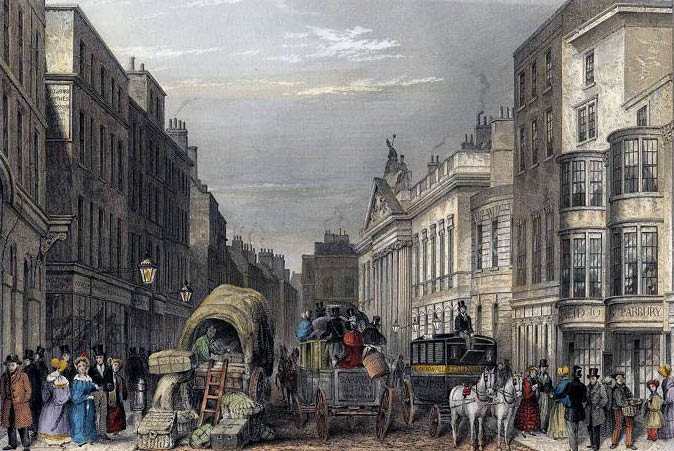
Leadenhall Street, London, 1837

(no date) Available at:
https://upload.wikimedia.org/wikipedia/commons/a/a7/Leadenhall_Street_J_Hopkins.jpg (Accessed: 7 February 2016).

Changes in society:

'Society was hierarchical, yet there was much social and geographical mobility. Self-made entrepreneurs used their new wealth to rise in society, building large houses, educating their children and employing domestic servants (by the 1880's 1.25 million people were employed in domestic service - more than in any other work category).

Middle class England grew rapidly and the upper class, which was formerly purely hereditary, came to include the nouveau riche, who made fortunes from successful commercial enterprises. However, a large proportion of Victorian society was still working class, and they remained disgruntled at the social inequality and eventually sought reform.

The franchise was gradually extended to the working classes, until by the end of the period there was universal suffrage for men. The fight for votes for women was in full swing, but it was not until 1930 that women achieved the same voting rights as men.

As a result of early campaigns by people such as the Earl of Shaftesbury, and reports by parliamentary commissions, legislation protecting child and adult workers began to be enacted. Important reforms included legislation on child labour, safety in mines and factories, public health and education (by 1876 education was compulsory for all children up to the age of 10). There was also prison reform and the establishment of the police.’


Victorian Britain: A brief history (no date) Available at: http://www.history.org.uk/resources/primary_resource_3871_134.html (Accessed: 7 February 2016).

Transport:

‘Railways continued to develop, offering mass transit for city dwellers who were able to spend time off visiting the seaside and participating in the new pastime of sea bathing.


From Brighton to Bridlington fashionable seaside resorts sprang up. Boarding houses were built along the seafronts of towns near to industrialised areas such as London, Manchester, Leeds and the northwest of England.

In London, the world’s first underground railway, nicknamed the Tube, opened in 1862.’

The Victorian era - 1837-1901 on AboutBritain.com (no date) Available at: http://www.aboutbritain.com/articles/victorian-era-1837-1901.asp (Accessed: 7 February 2016).


Omnibus

Look and Collection, P.J. (no date) London and north western railway single horse family omnibus. Available at: http://www.lookandlearn.com/history-images/XJ149768/London-and-North-Western-Railway-single-horse-family-omnibus?img=204542&cat=look-and-learn-collections&bool=phrase (Accessed: 7 February 2016).

Politics, the Arts and Science:


‘Politically, during the Victoria era, the House of Commons had two main political parties: the Tories and the Whigs. By the mid-19th the Whigs were known as the Liberal party and the Tories were the Conservative party. The Labour party only came into being in 1900.

Prince Albert was a keen supporter of the Arts and London blossomed under his patronage with the building of the Royal Albert Hall, the Royal Opera House, the Science Museum, the Natural History Museum and The Victoria and Albert Museum.

Poetry, literature and art flourished with the Bronte sisters, George Eliot, Oscar Wilde, Rudyard Kipling and Charles Dickens publishing popular works.

Scientifically, the Victorian era also saw huge success. Darwin published his Theory of Evolution and the Great Exhibition of 1851 showcased many industrial and technological advances in the specially built Crystal Palace. Sigmund Freud developed modern psychiatry and Karl Marx developed his new economic theory.

The Victorian era in Great Britain was a time of great change and progress and is still considered the Birth of Modern Times.’

The Victorian era - 1837-1901 on AboutBritain.com (no date) Available at: http://www.aboutbritain.com/articles/victorian-era-1837-1901.asp (Accessed: 7 February 2016).

Music:

'In the pre-Victorian age with the industrial revolution at it's peak, more people started to live in Urban areas. With the rise in population in cities and a need for entertainment Victorian music was created. During this era, the typical blend of music was vocal and instrumental. Instruments included the piano, strings, brass and woodwinds. Musicians from brass bands played for coalminers while at public houses pianists and vocalists were common place. Opera was another form of musical entertainment. Instead of the usual moaning or chanting of music, lyrics were introduced. 

Audiences were particularly strict on concert etiquette. It was a horror even if there was the slightest burp. It would be considered a scandal if you made even the most unintentional noise. Most people dressed formally when they went to a concert or other musical entertainment. 

Music halls were created when the theatre act of 1843 was passed by the British Government prohibiting saloons from adding theaters onto their saloons and running them without a license. So music halls were born. They were a source of entertainment for all British people in the Victorian era. 

Sir Arthur Sullivan was a famous musician. He wrote music for Shakespeare's play "The Tempest". Richard Wagner was another famous music composer. His music was one of the pillars on which Western music was founded. He lived near the end of the Romantic time period. Women started appearing on the musical scene in the Victorian time period. They could even earn money playing musical instruments. The Royal Society of Female musicians was founded after Elizabeth Masson, a female singer, was rejected by the all-male Royal Society.'

Terms, P.I. (2016) Music and musicians in the Victorian era. Available at: https://prezi.com/-6ghm7v1lhzm/music-and-musicians-in-the-victorian-era/ (Accessed: 7 February 2016).


This is a video of a song called 'Where the bee sucks' by Arthur Sullivan for Shakespeare's 'The Tempest'. 

Bruce Greengart (2015) ‘Where the bee sucks’ from THE TEMPEST by Arthur Sullivan. Available at: https://www.youtube.com/watch?v=QtDymTHeJ9Q (Accessed: 28 March 2016).

Sports:

'Even though the Victorian era is littered with a lot of poverty and trouble for many of the citizens of England, they still found a lot of time to enjoy sports. In fact, still the most popular sport in the world today, Football (Soccer) really did originate as more than just a casual game.

It was during the Victorian era in 1871 that the first ever Football Association Cup (FA) was played. Many football clubs started to pop up such as Aston Villa and Everton. Although they were primarily organized by churches to encourage people to attend church, some were set up by employers with the intention of bringing in good players to win more games.

It is shocking that the game only originated as a way to keep people healthy. People began to get so serious about it that, by 1891 penalty kicks and other rules needed to be established to ensure that the game was played fairly. It was in 1880 that the first match between Australia and England was played. The sport of Football quickly began to attract large crowds with many fans.

The sport for women though was certainly croquet. Victorian women were considered to lack in both strength and technique in anything that they did. Therefore, croquet was supposed to be a sport that did not require either. The Victorian people, particularly women, really did enjoy it. It never caught on with men like it did women at that time, but it was a sport that both men and women could play together so it was certainly something that the people enjoyed and took seriously.

Cycling also became extremely popular in the Victorian era. The safety bicycle was up for sale in 1885 and was by far the cheapest form of travel. A lot of times the evening hobby would be for men and women alike who lived in town to ride their bikes out into the countryside. It was a good pastime that eventually caught on as a sport later on.'

Home (2016) Victorian games & sports, tennis, cricket, football, Croquet, cycling. Available at: http://www.victorian-era.org/victorian-sports.html (Accessed: 7 February 2016).

A group of women playing croquet

(no date) Available at:
http://www.avictorian.com/sports/Croquet_all_England_Wimbledon_9Jul1870.jpg (Accessed: 7 February 2016).